
Is Netflix Cheap Yet?
At the time of this analysis, Netflix was priced ~$70/share.

The Compound Comeback is first and foremost an educational platform. This is my first analysis of an individual company, and it’s not a stock price forecast. It’s a walkthrough of how to assess risk and think about a price of entry using the first principles of valuation — Netflix just happens to be the stock everyone’s arguing about right now. The stock is down substantially from its all time high of ~$134/share back in June 2025. Most of that drop came in December, after Netflix agreed to buy Warner Bros.’ streaming and studio business for $83 billion. Netflix walked away in February and the stock is still down.
The Business:
It’s Netflix. You know what Netflix is.
Balance sheet
Debt isn’t automatically bad, but too much of it can be a structural vulnerability. A company with little debt has options. A company drowning in debt has orders.
Netflix carries about $14B in total debt against $9B in cash. For a company projected to produce roughly $12.5 billion of free cash flow this year, that’s manageable. But a healthy balance sheet is a filter, not a buy signal — it’s a box a company has to check before I’ll look closer, not a reason to own the stock. Netflix clears it. That tells us the company is durable, not that the price is right.
Free Cash Flow
Financial media loves to talk about revenue, net income, and earnings per share; but free cash flow is what determines a company’s value to shareholders – it’s the money a business actually has left after paying to operate and grow.
The free cash flow compound annual growth rate (FCF CAGR) is the rate at which a company’s free cash flow grows year over year.
If a company were theoretically selling at its fair value, the stock’s fair value would grow in accordance with the FCF CAGR. Of course, a stock’s price doesn’t move that cleanly because of volatility and the market’s shifting interpretation of fair value, but a business is ultimately worth the cash it produces for its owners.
Netflix grew FCF from $243M in 2010 to $9.5B in 2025 — a 15-year CAGR of ~28%. This is phenomenal and on par with the long term growth rates for successful tech companies. However, when we’re assessing whether a stock is trading at an attractive price, we need to estimate the FCF CAGR going forward.
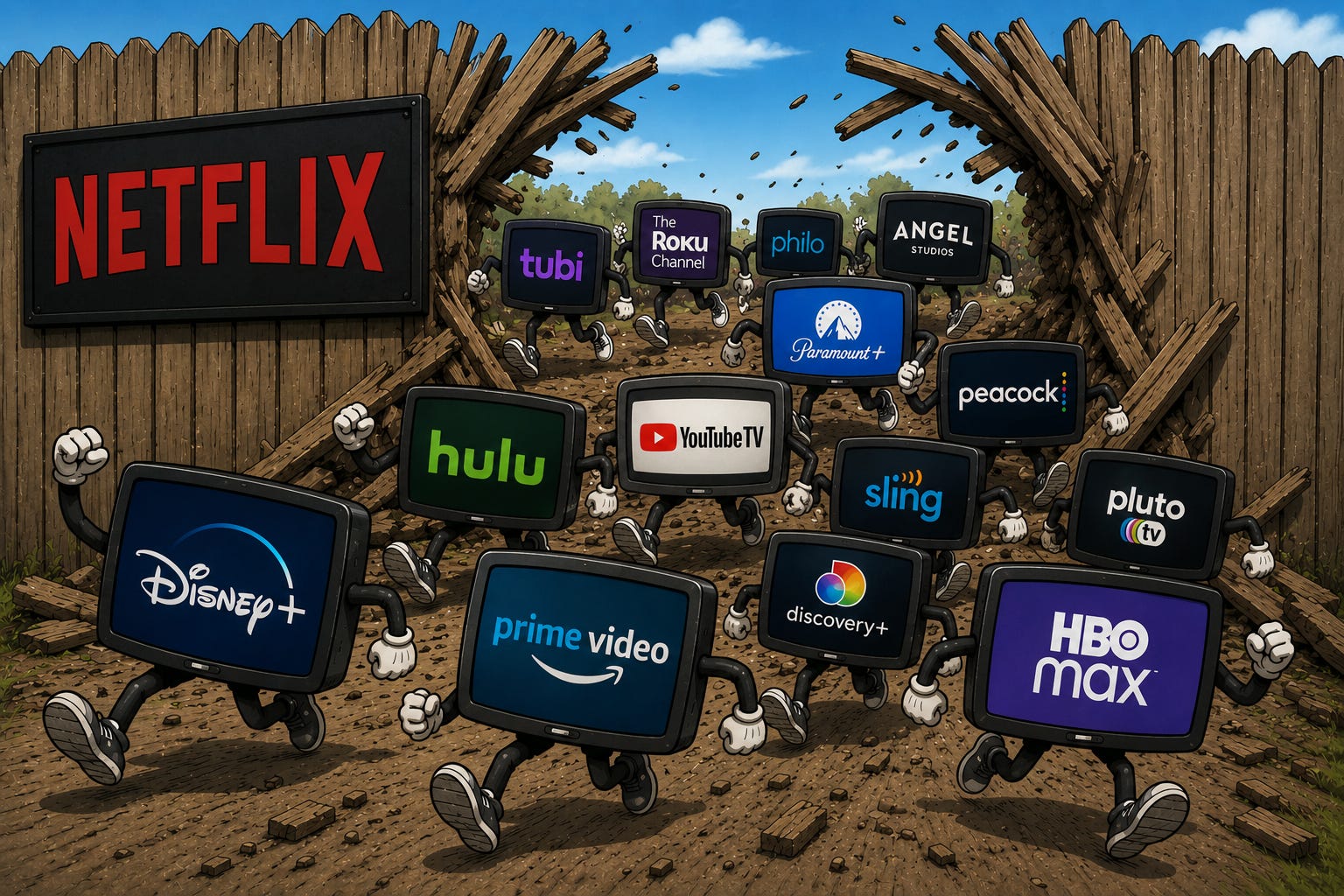
Some people might remember that Netflix started as a DVD mail rental business in 1997. In 2007, they pivoted into streaming and were effectively the only serious player in subscription streaming. Heading into 2027, Netflix is not only competing with the other streaming giants (Amazon Prime Video, HBO Max, Disney+ and Hulu); there is a massive list of other streaming services, ranging from free content like Tubi and Pluto, to niche studios like Apple TV and Paramount+, even culturally specific streaming services like Angel and OUTtv.
The Moat
A moat, in investing parlance, is a company’s enduring competitive advantage. If an established company has a strong moat, we can more confidently project its historical FCF growth into the future.
Netflix’s moat is under attack from multiple directions.
First, the market is saturated. Every new streamer in the list above chips away at Netflix’s share of household screen time and the path to more subscribers gets narrower every year.
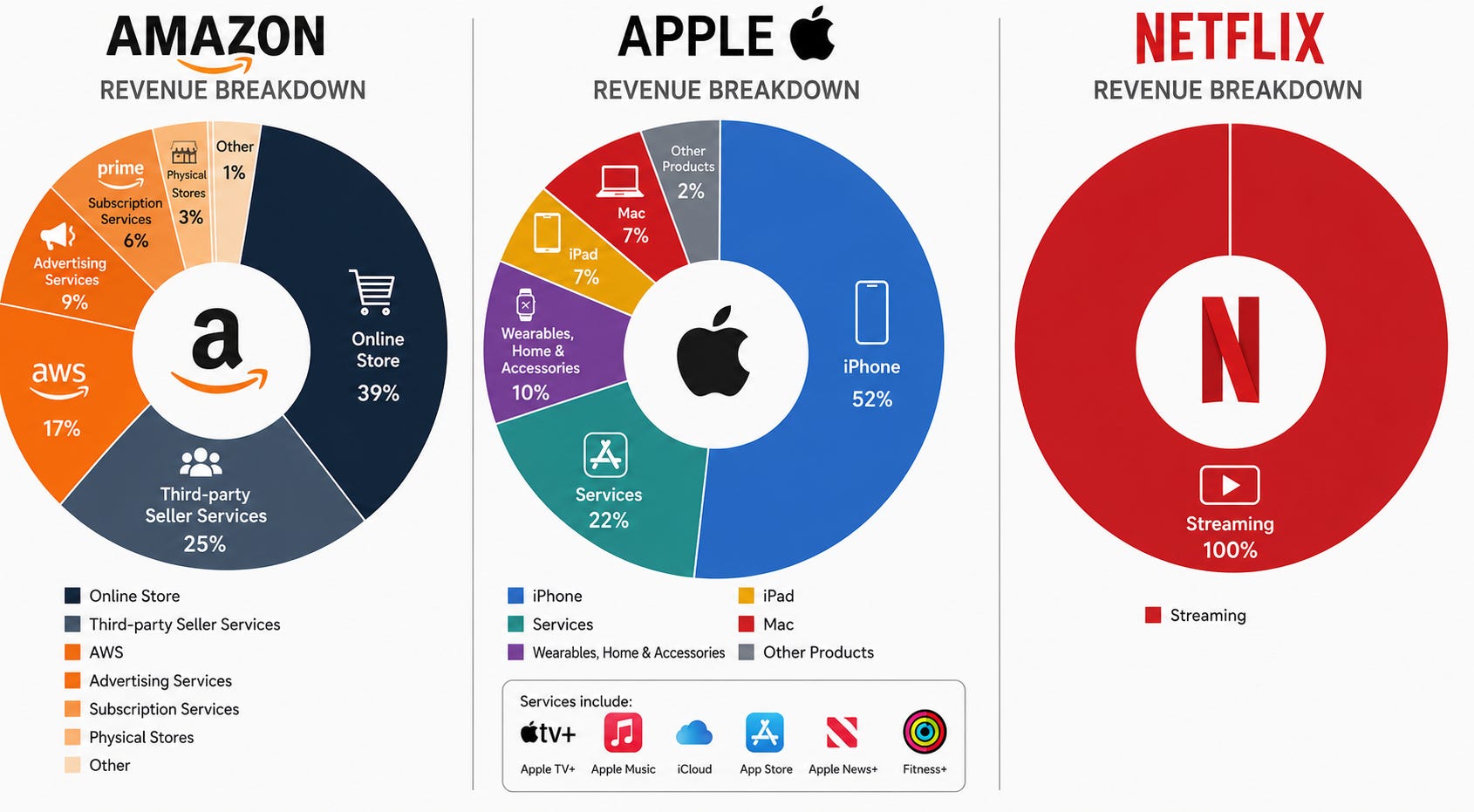
Second, Netflix has no fallback business. Apple’s core business is the iPhone. Disney’s is theme parks and the IP that feeds them. For Netflix, streaming is the business — win or lose.
Third, there are no switching costs. This is not a government cyber security company or an enterprise operating system. There’s a cancel button in the account settings, and every month every household makes a fresh decision. In that sense, Netflix doesn’t have subscribers. It has a rolling audience. That’s not a moat.
Netflix’s content library isn’t much of a moat either. Hits fade, contracts expire, and every dollar of FCF requires massive reinvestment.
Valuation
The discounted cash flow (DCF) model is a way of figuring out what a business is worth today based on an estimate of the cash it will generate in the future. It is one of the most widely used valuation models used by analysts across Wall Street. The model discounts those future cash flows back to today’s dollars — accounting for the time value of money and the uncertainty of the estimates — and the sum is the intrinsic value of the business.
Fortunately, you don’t have to have a master’s in Excel to run a DCF model – GuruFocus provides one for free. Looking at their DCF model for Netflix, the default settings yields around $80/share – about 15% undervalued.
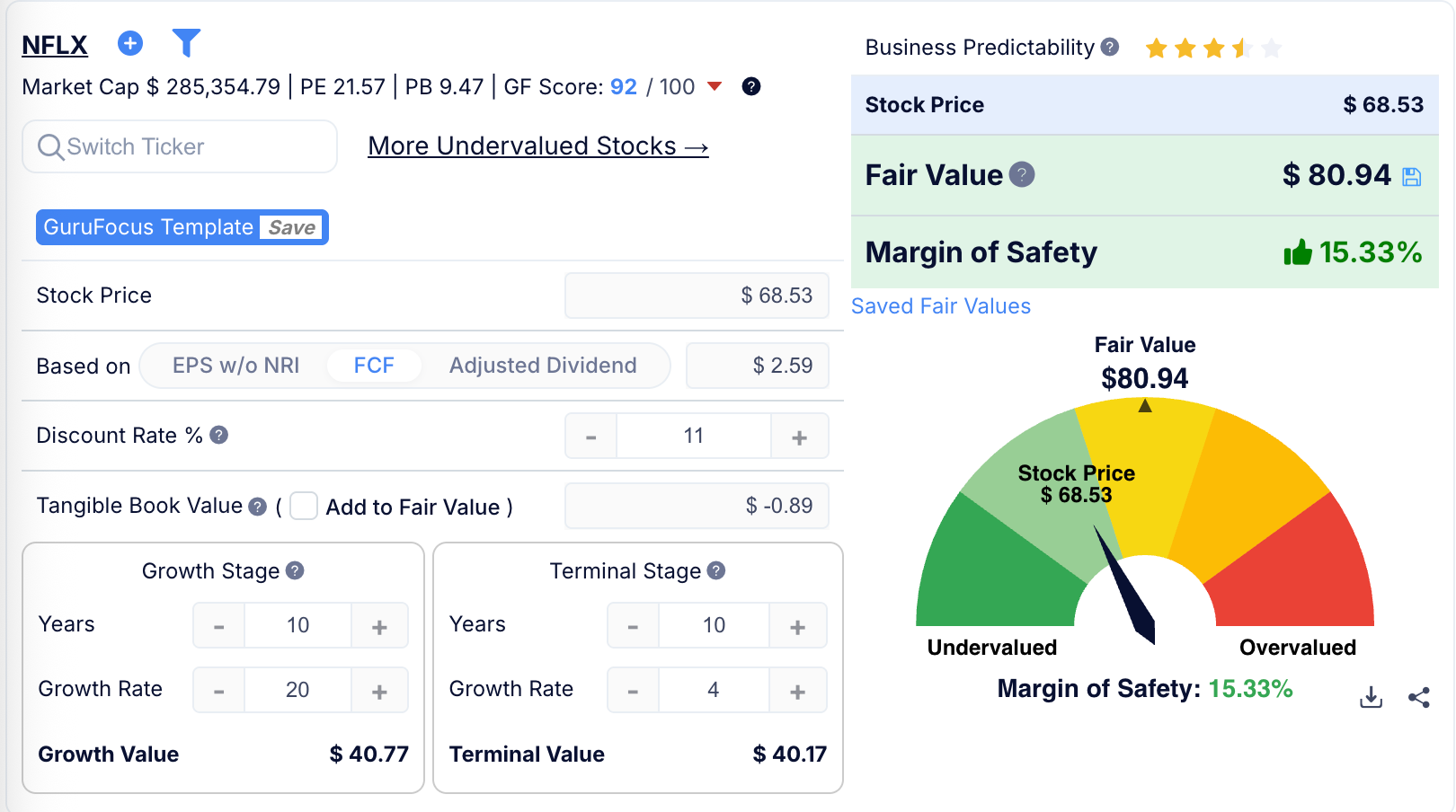
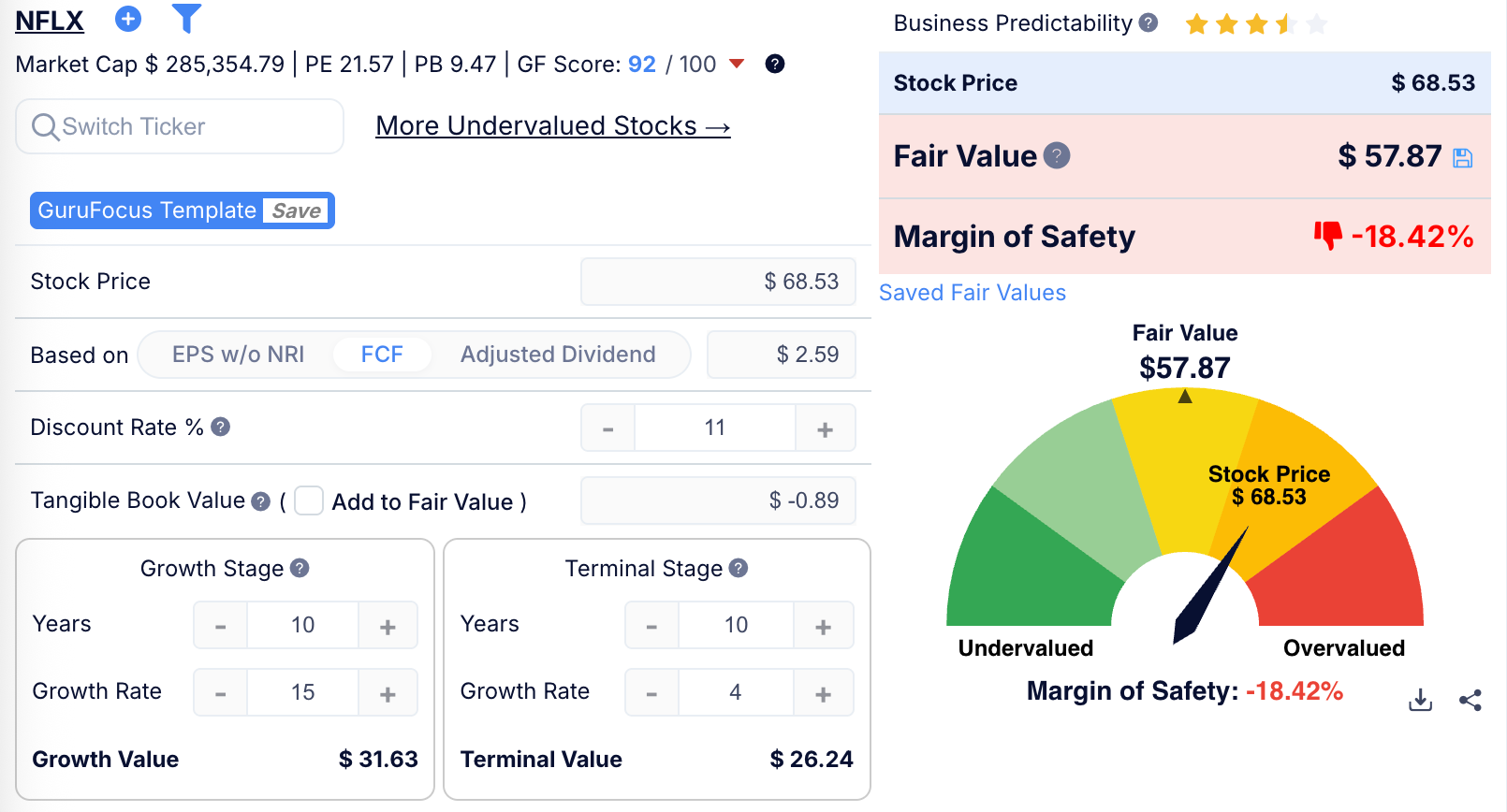
But one of the vulnerabilities of a discounted cash flow model is its sensitivity to inputs. If we turn the growth rate down to 15%, now the model says Netflix is overvalued by 18%.
If we reduce the growth rate to 12%, then the model says that Netflix is overvalued by nearly 50%.
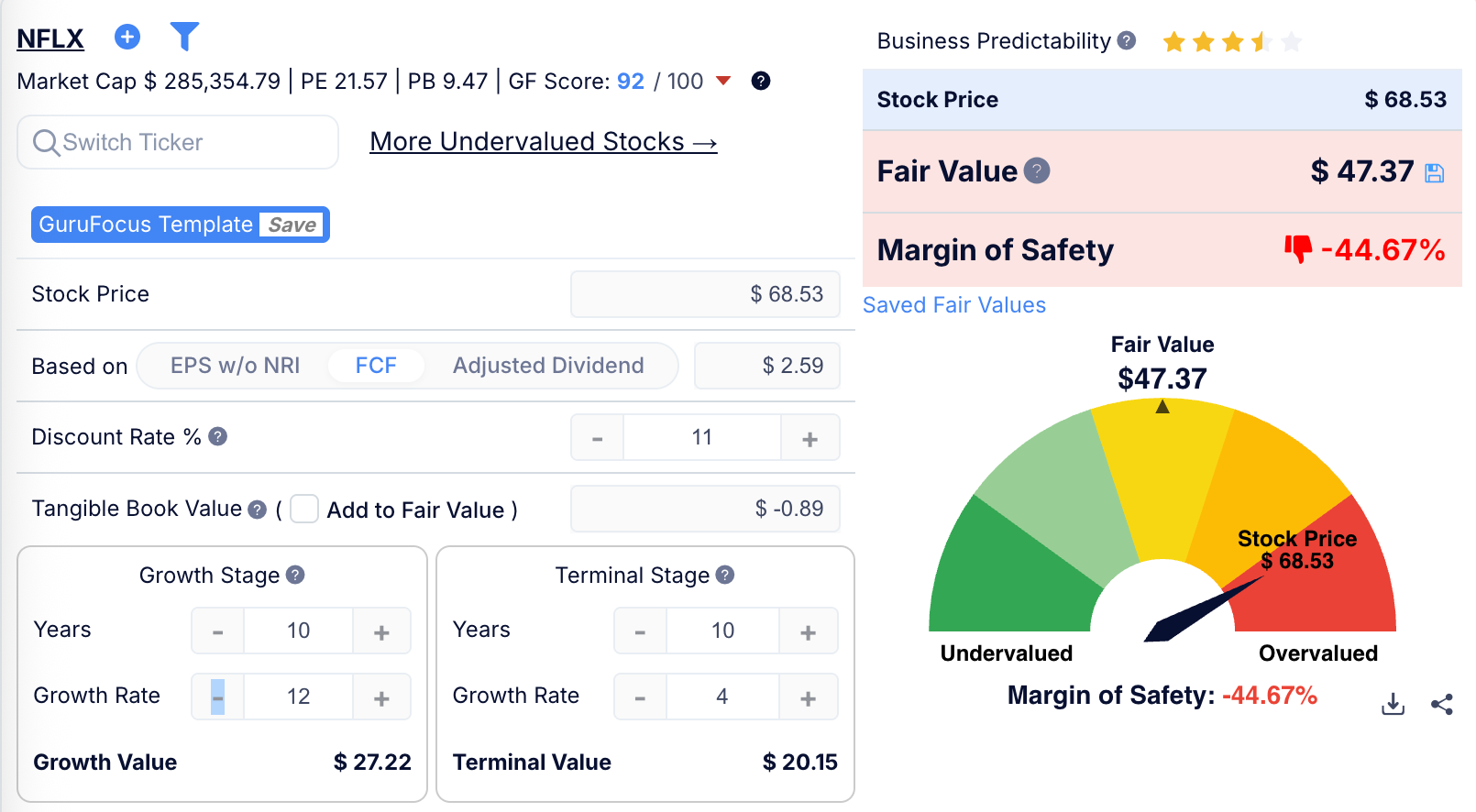
For the coming year, Netflix is projecting 12%-14% revenue growth. Although FCF is still high at the moment, most analysts are modeling long-term FCF growth at ~15% or less. For example, Simply Wall St estimates “Earnings are forecast to grow 11.39% per year.” Morningstar echoed the same sentiment: “The market has seemingly signed on to our view that Netflix will have difficulty maintaining double-digit sales growth in the long term.”
Netflix’s Expanding Margins Are Diminishing the Customer Experience
Real compounders — Costco, Amazon Prime, Apple — compound by giving customers more value over time. Netflix is doing the opposite.
This works as long as competitors are worse and Netflix has hits. Amazon, Apple, and Disney can afford to lose money on streaming because they make it back on retail, iPhones, and theme parks. Netflix can’t. When the current tailwinds — margin expansion, ad tier scaling, password crackdown afterglow — run out in 3-5 years, Netflix is likely a mature entertainment business with no fallback, priced today at compounder multiples.
Here’s what that looks like:
Price hikes → customer pays more for the same product
Ad tier → customer watches ads for what used to be ad-free
Password sharing crackdown → customer loses shared access
Margin expansion → by definition, keeping more revenue as profit instead of reinvesting in the product
Every one of these is a “milk the customer harder” strategy, not a “make the product better” strategy. They make the customer experience worse, not better.
Does this sound familiar? It should. Cable TV spent a decade running the same playbook — raising prices, adding fees, packing in more ads while the product got worse. Netflix disrupted them by offering something better for less. The company that killed cable is turning into cable. That’s the life cycle of a lot of innovative businesses.
Shareholder Signals
Whether management is reinvesting in the business, paying employees better, or acquiring another company, they’re spending money in hopes of creating more free cash flow down the road — an indirect value to shareholders. Aside from paying down debt or simply letting cash pile up, there are only two ways to hand value to shareholders directly: dividends and share buybacks.
Netflix does not pay a dividend.
Buybacks are when a company uses its cash to purchase its own shares on the open market and retire them. With fewer shares outstanding, each remaining share represents a slightly larger slice of the business — so earnings, cash flow, and future dividends per share all go up, even if the company itself doesn’t grow.
This is generally considered a bullish signal. If management thinks the best use of the company’s cash is buying its own stock, they’re effectively saying the shares are undervalued — that Wall Street has mispriced their business, and they know it. But that logic only holds if management is right. A buyback creates value only when shares are bought below what they’re worth. Overpay, and management is torching cash — handing selling shareholders a good deal at the expense of the ones who stay.
And Netflix has been buying back a lot of stock. In April 2026, the board authorized an additional $25 billion in repurchases — on top of roughly $6.8 billion remaining from a prior program. As Forbes noted, that new authorization alone is bigger than Netflix’s entire 2026 content budget of about $20 billion.
In 2025, Netflix repurchased about $9 billion of its own stock. All of it was purchased while the stock traded well above where it sits today, meaning that either management thinks the stock is now massively undervalued, or they were signaling to the market.
Insider Buys?
Management themselves can also buy shares on the open market — with their own money, at the market price, like any other investor.
This would be another bullish signal.
Netflix management hasn’t bought any open-market shares within the past year. This isn’t an allegation of any misconduct by management, it just means we don’t have both buying signals at once and we don’t yet know if the buybacks were indeed a bargain.
What’s More Interesting is What Management Isn’t Saying
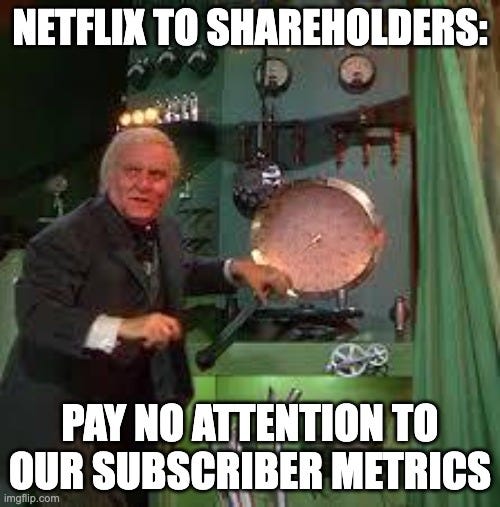
Netflix management recently said it would reduce the frequency of its engagement reports, changing the cadence of its “What We Watched” reports from semiannual to annual starting in 2027. This was after they stopped reporting subscriber numbers in 2025.
Co-CEO Greg Peters said on one earnings call that Netflix’s number of subscribers has been “a decreasingly relevant measure for the health of the company’s business.” He justified it by pointing to nuance in the business — new revenue streams, pricing that varies by plan and country.
Imagine WD-40 announcing that how many cans it sells is a decreasingly relevant measure of its business. Or Levi’s saying how many jeans they sell isn’t important. Netflix is a subscription company. But if the business really is that layered, why not report all of it — the new streams, the tiers, and — call me crazy — how many subscribers a subscription company has?
According to Morningstar, “Netflix stopped releasing subscriber metrics last year, just as we anticipated subscriber additions would begin to wane.”
So they stopped reporting the thing people were worried about, right when that thing was starting to give them something to worry about.
Again, this isn’t Amazon or Apple, where streaming is a rounding error next to cloud and iPhones. For Netflix, streaming subscriptions are the business — even the ad revenue comes from its own subscribers. The timing of that management opaqueness is seriously concerning.
Conclusion
I’m not saying Netflix is a bad company or heading for a crash, and I’m not predicting where the price goes next. But if you’re going to bother picking individual stocks instead of indexing, the bar is simple: the stock has to be mispriced.
So is it? Someone on another investing platform called buying Netflix right now a generational opportunity. But according to the principles of valuation, a stock purchased at fair value will only be expected to appreciate in proportion to its free cash flow growth. For Netflix, optimistically, that’s around 20% per year. Volatility can swing the price wildly around that baseline, but banking on more than that is speculation.
But 20% a year, concentrated in one company with one product, isn't a generational opportunity. That’s the best case, with everything going right: a good company bought at a fair price.
The trouble is that everything rarely goes right. Could Netflix blow the doors off — another string of global hits, ads scaling faster than anyone modeled, the stock ripping to new highs? Sure. But what’s the likelihood of that versus the FCF CAGR settling around 12% long term? That’s the question investors must wrestle with before buying at the current price.
The Compound Comeback is an educational publication.
Nothing here constitutes personalized financial advice.
Authors may hold positions in securities discussed and those positions may change at any time without notice.